Categories
Design HCId Journalism

For people who make things for people

Working together...
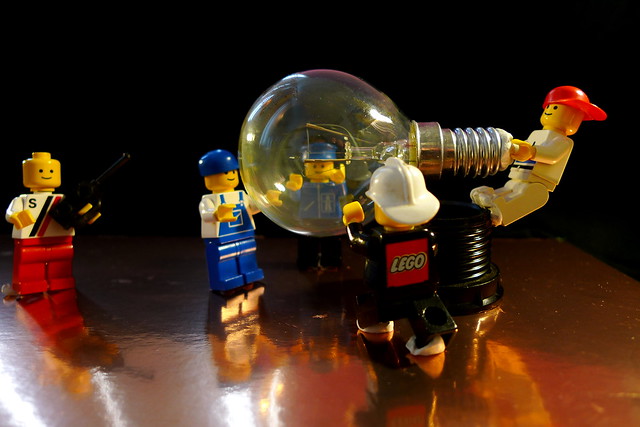
A great post from thingist with an articulate reminder that we are all in this together. When we lose sight of what we’re doing, the people we make things for often suffer the most–and isn’t that contrary to the whole point to begin with? Helping each other out rather than ripping a new one every here or there can’t hurt.

My fellow nerds, geeks, hackers, designers, makers, builders, and DIYers, there is something very very wrong with out culture right now. We’re jackasses to one another.

Except nobody told me that I sucked at skateboarding, or that my form was terrible, or that I should give up on it. In fact quite the opposite. One day at the skatepark I was sitting off to the side just watching everybody else and kindof wishing that I wasn’t there. One of my best friends, Steve, came up to me to ask what I was doing.

“You’re not going to learn anything by just staring at that thing. If I ever catch you sitting on this bench again, you’re not invited to the skatepark anymore.”

However, there is also a place for tough love and an honest, constructive critqiue.

[full post at thingist]
[photo via lollyman]

Categories
Design Journalism

Designing for interests, beliefs and values: how traditional demographics no longer drive the future of media

There is an upside to having your taste (and clicks) monitored by advertisers, Johanna Blakey of University of Southern California says.  It’s being respected, not presumed. Old media looked at age, gender and income to guess what you would like. You are not your demographic. You are your values, interests, beliefs and so much more. That is how you connect with people and new tools–social media–let you do the connecting with people on your own terms.

We use these tools to connect beyond gender, age and income. Now digital tools see who we are, what we like and what we want to do.

Blakely shows that women, by far, outnumber men in use and time spent on the social media space. If women control social media and social media is overtaking traditional media, will women overtake traditional media? If so, then are we going to start seeing more women in media? and more chick flicks? No! She predicts more women working in these fields will mean more interest and value driven media. No more ‘lame’ movies. Better content and smarter targeting, not for women, not for men but for all people. We cannot say whether or not women will ‘take over’ the media, but Blakely makes a good guess that they will drive the future of the industry.

Is there a future where I watch the Super Bowl and not see one car commercial unless I’m shopping for a car, which I discussed last year: http://nina.keystreams.com/2010/what-if-ads-werent-such-a-bad-thing/

Entertainment influences our beliefs, our work, our play and values. Designers, developers and managers must consider, explore and practice this. At a newspaper, we call our users ‘readers’ and in radio they are ‘listeners’ and on tv they are ‘viewers’ which were all valid titles because the communication and content went one way. But as soon as these people could interact with content, they came ‘users’ which is a shred more respectful than reader because it at least empowers them with the ability to use and interact.

Meaning, implication and tone get tied up in our language. ‘Users’ is a firstwave HCI term from the 80s, at least, that dehumanizes the people we are talking about. The word came about when ‘interaction designers’ were concerned with usability, efficiency and  — well — use. As we consider the values, beliefs, ideas and interests of the people who use the things we design, our language needs to change too. What should we call these people? I don’t know yet. But thinking and talking about as more than users or humans, but as people will likely change the way we work.

Categories
Capstone Journalism Share

The Revolution was not tweeted: Tunisians in action

TUNISIA-PROTESTS/

Twitter did not go to Tunisia and tell people to revolt. Last September I asked about power in the information age. Who has it? And what is it? If we can get access to nearly all common and not-so-common knowledge, instantly, is knowledge power? Indulge with me for a moment, and let’s say no, knowledge is no longer power. Then is our network the power?

Someone who is connected to a listening audience, who is connected to a listening audience, who is connected to a listening audience is quite powerful. That has always been powerful, but now nearly anyone with a tether to the digital world can be any of those someones. And they have the potential to be quite powerful figures. Save of course that these “powerful figures” are not always recognized as such because they flow in and out of the role as a leader if you consider Ben Schniederman’s theories about consumers and producers online.

The revolution was not tweeted. The revolutionaries in Tunisia were just on Twitter. They spread their ideas fast which got them up, out and in the way faster. Twitter just made it easier for the People to say, “Listen to us, now.”

Matthew Igram via GigaOm writes

But is anyone really arguing that Twitter and Facebook caused the revolutions in Tunisia or Egypt, or even the earlier public uprisings in Moldova or Iran for that matter? Maybe cyber-utopians somewhere are doing this, but I haven’t seen or heard of any. The argument I have tried to make is simply that they and other social media tools can be incredibly powerful, both for spreading the word — which can give moral or emotional support to others in a country, as well as generating external support — as well as for organizational purposes, thanks to the power of the network. As Jared Cohen of Google Ideas put it, social media may not be a cause, but it can be a powerful “accelerant.”

Did Twitter or Facebook cause the Tunisian revolt? No. But they did spread the news, and many Tunisian revolutionaries gave them a lot of credit for helping with the process. Did Twitter cause the revolts in Egypt? No. But they did help activists such as WikiLeaks supporter Jacob Appelbaum (known on Twitter as @ioerror) and others as they organized the dialup and satellite phone connections that created an ad-hoc Internet after Egypt turned the real one off — which, of course, it did in large part to try and prevent demonstrators from using Internet-based tools to foment unrest. As Cory Doctorow noted in his review of Evgeny Morozov’s book, even if Twitter and Facebook are just used to replace the process of stapling pieces of paper to telephone poles and sending out hundreds of emails, they are still a huge benefit to social activism of all kinds.

In October, Gladwell said the revolution would not be tweeted. He said our thousands of weak ties won’t make change happen. Soon after, I questioned the power of (Facebook’s) algorithm that aims to reduce information overload and weed out irrelevant content. Doing this, however, there’s no way to protect yourself from over tweeting. The conversation is always streaming and always linear. So then, if you tweet often are you more likely to get ignored or at least get some views.

It depends if you’re a loud, verbose person at a loud party or a quiet person, at a quiet party, saying one, striking thing every so often. The problem here is that everyone is at a different party. Then why, if everyone is at a different party, did the demonstrators catch word so fast?

It’s the two-step flow, 2.0. The beautiful flow of information that embraces the idea of human agency to share knowledge and information. But now, unlike ever before, anyone has the potential to have the power the mass media once had.

We can’t help but keep asking if participating in social media is activism. Does changing a Facebook Status or Twitter profile picture make a difference? Some argue it brings awareness to an issue. But it’s passive activism, it’s enough to get points for “caring” about an issue for a fleeting trend.

Why then is a riot, a protest or a lunch counter sit in considered considered activism, when it too, is also just spreading awareness about an issue? Because it causes disruption. The actions do not ask the community to stop what they are doing and pay attention, they require it. It gets in the way, it upsets people and it makes people talk about the problem.

No. The revolution will not be tweeted. No the revolution was not tweeted. But yes, our new tools inspired conversation that empowered people to put the problem in the way. Whether or not that is Good is another question.

The revolution happened on the streets.

Categories
Capstone Design HCId Journalism

The Social Journalist

brain exploration
Broadcasting stories to social media has led to the emergence of social journalism.

Social Journalism (definition in progress)
Social Journalism is the practice of broadcasting a news story with commentary to a social network. The social journalist practices writing, editing, judgement, authority, attention to audience .

Argument
The social journalist does not necessary practice news gathering and fact checking like a news journalist does. This person scrutinizes text and through their horizons, interpretation and the context of their lifeworld, they comment on the content in the context of ‘convention, reception and interpretation’ in a social way, as Barnard says in his book Visual Culture.

Commentary
I’m in the process of brainstorming for a paper I am writing. In my research, I have found that  people who share and comment on news stories to their social networks and news journalists have many things in common. This paper will argue for the emergence of the social journalist and will explore how sharing UI on news sites have enabled this emergence. This paper will also acknowledge the differences between news journalist and social journalist. Social media and its integration with news media, for the first time ever, has empowered the lay person for to be not only a consumer, but also to produce content and easily broadcast to mass communities.

Categories
Capstone Design HCId Journalism Share

Design sharing tools for the creative process

Narrative (The Creative Process)

Sharing a news story usually seems like simply flicking a click of a button, scribbling out a quick thought and going about your merry way.

But news consumers, who once, were only news consumers are now also producers. Beyond the blogger, only recently has design and technology facilitated the tools to empower the lay consumer to interact with content in a creative way. They are now work as editors, writers and broadcasters, in their own social right.

John McCarthy and Peter Wright compose a fantastic book on experience design, Technology as Experience. “Experience is ever present,” they say. “We are always engaged in experience even when we are trying to stand back from it to describe it.” McCarthy and Wright reaffirm how it important it is to think about and the holistic experience of anything when designing, and in this case, sharing a news story.

Browsing through news stories is absolute active participation. Unlike watching news TV or even reading a print publication, the reader has choice more choice between on and off or skim or not skim. In the current content consuming paradigm, beyond a news summary, the reader must actively decide to click, and almost navigate to a new page to get immersed into a story. It takes a significantly greater commitment. The reader then must actively make a judgement, “do I want to consider reading this article?” If yes, they click, if no, they keep skimming headlines and photos.

This is the first step of what I’m referring to as an editing process, where the reader is flexing their judgement skills. Moving forward, they continue to do this when they’ve consumed enough of the article or graphic and decides to share it. Only now, after all of these hurdles, have they come to the act of sharing something. That standing on the assumption that the sharing interface (and logging in process for that matter) is seamlessly easy to understand.

If the article inspires and resonates with the reader, it’s likely it has a high share-ability. That or it speaks to the readers’ audience, the audience that is comprised of their network. Of course, considering, most people don’t think about the Facebook News Feed is developed in such a way that it’s difficult to overshare to your network, according to Aditya Agarwal, Facebook’s Director of Engineering. Though, they are hoping people will learn and stop worrying about overshare.

In Erik Stolterman’s book, Imagination and Communication, he talks about imagination and communication. The reader takes ideas from their minds eye and must make it communicable, he says, which is part of the creative process.

Once the reader has read the article and formed some kind of thought and new meaning, it still exists in their mind, in their imagination. Once they have taken that vision, explored and then written their thoughts, they have led to “new truths” cited to Erik Stolterman. Their new truths, that are “possible to share with other people.”

And beyond all of this, conscious or not, these readers are engaging in civic and cultural participation, which Jean Burgess, author of Vernacular Creativity cites.

Culture is the means by which we, as individual citizens and communities, experience what the world is like, how we fit in it, and importantly, how we relate to others who are different from us at the same time as we seek out opportunities for belonging.

Where participatory media opens up space for us, as ordinary citizens, to speak and represent ourselves and our ways of being in the world, and to encounter difference, then it’s also a space for the everyday practice of cultural citizenship  in that context, everyday creativity is civic engagement, in a sense.

It is not even the writing process itself here that is creative and expressive. It is the development of new truths, personal meaning and broadcasting in a cultural context to an audience, especially at such a mass scale, that has never been done before. Participating in every day media, like Burgess says, helps us develop our own identities, how we see ourselves and how we fit into our worlds. All the while we are making judgements about the what the people in our networks share, say do, and don’t do and how they fit into the world. That has always been a part of civic engagement.

When designing a share UI, designers must consider:

  • The overall experience from arriving to the article in the first place. How did the reader get here? RSS, Website, another shared link? Think about where they are coming and possibly where they are going afterwards.
  • Consider when they are likely going to want to share.
  • Design the UI with enough space that supports an emergent writing and editing process, like a resizable window.
  • Think of the reader as a media producer. Is your share UI a pop up or modal dialoge? Will they lose everything they wrote if they go to reread a section of text, navigate to a new site to get some information or another link or copy and paste something?
  • Reduce the amount of choices they must make. The New York Times does a nice job giving commentary a high position in the visual hierarchy, while still giving their consumer/producers the autonomy to hit recommend without saying a word, which still says something.
Categories
Capstone Design HCId Journalism Share

The shared experience

Gorilla Sharing 2

Sharing a post seems simple enough. Copy and paste a link, click the like button or recommend a story. Seems simple enough–not too complicated. There is a lot more happening behind these 1 and 2 step flows. When we share we are defining our identify, building our social capital and simply speaking, expressing ourselves.

Takin the action to share, or not share, by whatever process is an editorial process. Creative tools like Facebook give people who were once only consumers a more liberal opportunity to also be producers.They are using their personal judgement to select or ignore what they choose to broadcast to their networks. Each post is a reflection of  their values by showing what they consume and promote and thereby constructing their identity.

Schniederman and Hochheiser discuss the transformation from readers to leaders in social media. Social media users are constantly shifting from roles as passive readers to very active leaders: those who move conversations in the community forward. In between they act as contributors and collaborators and are constantly negotiating their role and identity as it shifts even from post to post within their greater social communities online.

Sharing to a community also builds on social capital. Journalism history researcher discusses the orientation of text in his book Communities of Journalism.

“When a reader writes a letter to the editor, they are speaking to the public, speaking to the editor and to the self,” he says.

Nord’s statement here supports identity building while interacting with news. What also happens here is engagement with the community. Posting and sharing certainly speaks to a public, especially as the web is becoming more open. Friends in the network work as editors, they critique, comment and build on what has been stated. As a person shares to their network, the public and editor are one in the same as they are building their social capital.

In a recent study done at Michigan State University, Ellison, Stenfield and Lampe found significant social capital benefits from college students on Facebook. They found students used facebook “primarily to maintain existing offline relationships or to solidify what would otherwise be ephemeral, temporary acquaintanceships.” In doing this, they found “indices of psychological well-being, such as self esteem and satisfaction with life.” Sharing and engaging in these communities not only pass time and serve as passive news to read about friends, but also builds socially beneficial experiences.

Malcom Barnard quotes Roger Fry in his book Approaches to Visual Culture. Barnard writes:

Fry believed that message of the work is described as’a whole mass experience hidden in the artist’s subconscious’ Conscious or unconscious, the matter is still that of expression.

When someone share to their network, whether or not they are conscious and aware of their expressions does not take away from them expressing themselves at are. When they post, and especially with commentary,  they are engaging in editorial, creative work and the process of communication.

In doing this, their expressive nature directly relates to their identity that is always in progress of being crafted and the social capital in which they are building. The individual does this across their networks, their community while every other friend in their network is simultaneously making the same conscious and unconscious negotiations.

Categories
Design HCId Journalism

“The computer is really a tool for creativity and creation.”

“There’s value to doing things by hand, there’s value to having an algorithm for you. Design and the world of data. There’s a lot happening there. Think about information design and how you can effectively tell a story by data.”

via Karl Gude

Categories
Capstone Design HCId Journalism London Music Poynter Share Travel

Make music, make friends: my social graph

I wish I had drawn out my interpretation of my social communities before I installed the new Facbeook app, Social Graph. What this app does very well is show me how my facebook friends are connected and clustered.

I ran the app, took a screen grab and began to label the clusters. When I loaded the app again, my clusters looked different. In these screen grabs I did not include some of the outliers. Most of those people are friends I made while traveling. There are so many ways to interpret my social circles. The app is slow right now and it doesn’t tell a story. But I can do that:

My Social Graph

Ultimately, what I found is that my techno community links my high school and ancestry communities the most. Media and music are still the center of my social circle here. My current job at the Office for Women’s Affairs is surprisingly barely connected to anything at all. I have two London networks that don’t overlap at all.

My Social Graph

I can see that media and music are the centrally what link me to people and my professional communities. I have strong clusters in Indiana and San Francisco that thickly overlap with my Chicago community.

My Social Graph

I found many of the outliers here to have a specific ethnic quality in common. I also had an absolutely random seeming smattering of “indian people” from all over the country in that cluster.

Overall, I’ve learned that my music communities centrally have guided my social life. I have an enormous high school network, which makes sense because I joined Facebook as soon as I graduated high school. My Bloomington music community is tightly connected to my student media groups which then led me to my job at the Star, the news design community, my Poytner Fellowship and the cluster of friends in Indianapolis who worked at Rolls Royce.

Last year, friends from my San Francisco Tech and Techno Community went to India for a wedding. They stayed with my aunts, uncles and cousins and must have friended each other. There are enough people from my high school who moved to San Francisco, listen to Techno and work in Tech, so we can see those overlaps too.

I was surprised how few links there were between my tech communities and RockMelt, but then again it makes sense because I did not get the internship by knowing someone, per say (which is quite rare). There was a 6-degrees of separation alumni connection there.

I wish I could make some sense of the random smattering of Indian people. That cluster is concentrated with Indian people I know from all over the country and world. I guess we really are all family.

I would love to search for specific friends in this app. Still, very cool. This is also the first time I got to check off every category in my tags!

Categories
Capstone Design HCId Journalism

What if ads weren’t such a bad thing?

Advertisements are annoying because they interrupt whatever it is that I’m trying to do. Ads disrupt my reading, my hulu-watching, steal attention when during searches and force you to chase your mouse around a dancing logo hunting for the ‘x’ icon. I cannot recall a time when associating your brand with words like annoying and frustrating was a good thing.

We are in a flow when we’re reading. Researcher danah boyd talks about Csikszentmihalyi’s flow theory in the context of media online:

Consider what it means to be “in flow” in an information landscape defined by networked media, and you will see where Web 2.0 is taking us. The goal is not to be a passive consumer of information or to simply tune in when the time is right, but rather to live in a world where information is everywhere. To be peripherally aware of information as it flows by, grabbing it at the right moment when it is most relevant, valuable, entertaining, or insightful. Living with, in, and around information.

boyd is not talking about advertisements here. Not directly at least, but it fits in. Usually, ads are persuading their targets to buy something. Usually. But, often, people do come online, to indeed, purchase something. The advertisements are frustrating when people are not shopping or the advertisements are irrelevant. The ads are frustrating when they don’t fit into our flow and rarely do they.


Example: If Cheryl Sundra has been shopping for cameras lately, I bet she would love to know that Kyle Telechan uses a Nikon D3. She thinks his photo is “fantastic!”

But for now, advertisements are a part of our world. Some news companies especially still cling to the ad model for a way to pay for server space and their reporters. But how is it that an entire industry built on paying for their product with subscriptions and ads missed the boat again?

According to insidefacebook.com:

Facebook has filed for an ad targeting patent that lets the company direct ads based on the tastes of a a user’s friends, on top of their own explicit interests.

But it also covers other twists on the idea, including using a person’s browsing habits or actions on the social network to target ads. Although the patent document only appeared earlier this month, the company filed for it in April of last year.

Facebook argued in the filing that self-reported interests often leave out people who might fit within a targeted group for an advertiser. The idea would be to help marketers reach potential customers who haven’t shared enough information about themselves to feed Facebook’s ad targeting algorithms.

Educated, connected readers, probably with credit cards, are reading the news online. Sure, the news sites has access to user browsing habits. But that was when they were just users. Facebook transformed these users into people. People with relationship histories, favorite restaurants and absolute easy access to the kinds of people and places that are important in their lives.

Facebook filed for this patent. But surely the news is already working on something. I’m personally putting a lot of eggs in the news.me basket.

Categories
Capstone Design HCId Journalism Share

It’s halftime: it’s time to synthesize

Call it expanding and contracting, cycling and then recycling or moving forwards and backwards. That’s the way research goes. I am midstream a thick media reporting project. As I sort through my quasi-professional-identity crisis as a designer, journalist and researcher I have full warrant to borrow tools and techniques from all disciplines.

I borrowed elements of affinity diagraming to draw new conclusions about so much of what I have learned this semester.

I'm supposed to find meaning in this stack?
1. I wrote short summaries of my research findings on individual Post It notes.

Diagram findings
2. I stuck the post it notes on a big blank wall. I organized and reorganized them until they made some kind of subjective, judged sense.

The big topics
3. Then, I gave each stack a topic. I now have organized clusters of thoughts and seeds of ideas about how to move forward.

Questions

  1. What kinds of people should I talk to next?
  2. How does language connect communities and culture?
  3. What are the analog things in our life that mimic the social layer?
  4. What gap is social media sharing expression filling?
  5. What filled the expression gap before?
  6. Will we get social media fatigue (too many chicken nuggets)?
  7. Social media satisfies impulsive behavior and thoughts. What other part of our life does this affect?
  8. Why do we gather where we do online?
  9. What gets left out when shared (broadcasted) content is personalized for us?
  10. How are people who share to social media like and unlike journalists?