
Quite simply no. Dave Winer recently wrote “web browsers are done. Feature complete.” I refute this for a reason I perceive to be quite obvious: browsers must keep changing because people keep changing. Their needs, their wants, their economies, their mood and their lifestyles all influence what needs to be done next for the web.
URLS
How we get to wherever we’re going on the web has already changed. When the web formally and broadly platform for how we distribute information and communicate it will become more obvious why browsers have a long way to go. With Icann’s announcement to increase domain suffixes available, we could potentially travel to http://fanta.coke or http://maps.google instead of a traditional .com, .org, .gov suffix. Chrome released the omni bar which merged manual URL entry and the search for content. Browsers (on many devices) serve as portals to information and the web as as a platform for Saas then there is much work to be done. URLs are fading to the background as a primary way to navigate to information we seek.
 Saas
Saas
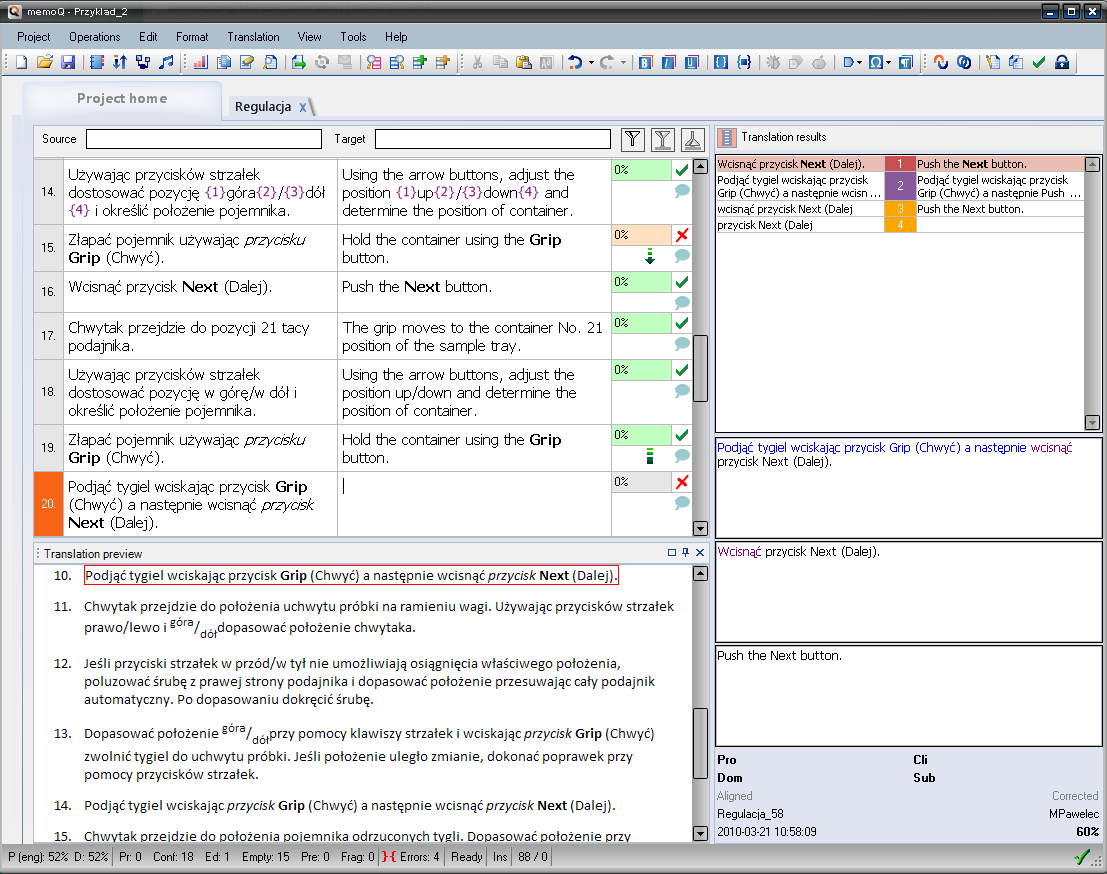
At myGengo, I worked on a web-based UI for translators (not shown). Before they were either using Microsoft Word or a plain text editor. Professional translators who do mountains of translation use professional tools like MemoQ (right). The software allows translators to work relatively efficiently but a lot of UX needs are unmet. I worked on this problem. My goal was to improve what myGengo had already built and weave in the powerful features these pieces of software have. I needed to do it in a way that makes sense and moves the language, translation and communication industry forward. All of course, to be done within the browser.
Universal Logins
I worked on the alpha launch of RockMelt. What their service does better than any other browser is the universal login. It’s front facing, it’s required, it gives users more context and it’s quite clear what happens as a result of the login. If or when they (or Chrome or Firefox) leverage universal logins beyond personalized data synced, I think we’ll see more fluid way to explore the web. When we can eliminate or reduce login barriers while still offering personal security and stability and clear communication to users what has been done, we will move the web forwards.
 The CR-48 Chrome Notebook (rigt) seems to be working towards this goal I reviewed the Chromebook in April. To promote an idea that the web is where we can do all of our computing is an idea they are working to materialize. It has a ways to go but the philosophy is not wrong.
‘RockMelt is just a bunch of plugins’
I get a lot of questions about RockMelt. They recently raised $30 million in funding and people ask me why. They tell me it’s either too noisy or it’s the same as all the apps or plugins they’ve added to Chrome or Firefox. How many people know what a browser is, how many know what a plugin or app is? I don’t have the numbers but my prediction is quite low.
When people ask about Rockmelt, I say:
- RockMelt users LOVE the RockMelt. First and foremost. And it’s true.
- Their team and projects are well managed and organize.
- The team had a diverse (technical and cultural) background whom are wonderful, smart people.
Anyway, let’s say it is a browser with a bunch of plugins patched on top. What’s the harm in doing a little legwork for your users? A browser with features for people who love consuming and producing content on the web is not a bad idea. It would be interesting to build a browser business where you just package up features and distribute them to niche audiences. Do you think cheese heads in Greenbay would love an ESPN browser? Or the brokers on Wallstreet, with a Bloomberg browser? Is their an audience for the Sudoku, Crossword, Plants vs Zombines browser? I’ve been wanting to see RockMelt is opening up a door here.
Mobile
The obvious bridge for mobile and desktop browsers has been syncing content. I’m excited for the next stages where we have smart and helpful geo-location services, better ways to communicate fluidly across platforms (and Facebook has done a good job with this so far) and brilliant ways to find exactly who or what I’m looking for (even if it’s something to suck time while I wait) depending on what I’m doing and how I’ve been browsing.
I can understand why Winer wrote the post he wrote. But I would like to learn from him how he thinks technology, economy and culture will more forward without the (desktop, mobile, wrist watch, taxi cab, restaurant menu, etc) browser being a primary portal for business and play. Look to for Globe Trekker (who makes a good discussion about HTML standards) and Adaptive Path for alternate perspectives. I welcome yours in the comments.
What Winer’s post does do well is motivate an important conversation in a public space. If the internet really was some kind of information super highway, Winer would be sitting in the back seat asking “are we there yet?”

