Categories
Design

When the designer bubble goes pop

Design Bubble goes Pop

“Hey, the economy is going to turn around in the West,” I yelped across the living room to my roommate. She poked he head around the side of the door,

“What? When?” Flipping through my favorite issue of The Economist, one that foreshadows the following year, I tell her things are turning around for the Americas, Europe and Japan. I flip a few more pages and see the word “tech” in a headline with an image of an occupy protester.  I lowered my brow and shoulders as I read the coming tech-lash.

“Nevermind. Not here…”

“We live in a bubble,” says Eric Schmidt, the chairman of Google (and a member of The Economist Group’s board of directors), “and I don’t mean a tech bubble or a valuation bubble. I mean a bubble as in our own little world.” This little world has been protected from popular anger about inequality. The popping of the bubble will be one of the biggest changes in the political economy of capitalism in the coming year.

This isn’t the first bubble and it won’t be the last. But Schmidt gets to the social issue of the bubble, disengagement. This same article gets beyond the millionaires and billionaires, but the young elite.

The oligarchs sit on top of a huge money culture: Silicon Valley is not only minting but thousands of young people who pull in more than $100,000 a year…[spending] money on sci-fi flavoured projects…

We came here to do things differently. Not for different’s sake, but because there was a better way. We wanted revolutions over old systems. Broken systems. People here call it disruption.

We were Software People up against The Man. Somewhere along the way, some of us became The Man. As the energy shifted, we saw more and more photo-sharing-coupon-marketing-analytics apps. And less disruption.

But it hasn’t been all bad. As my personal career shifted from straight-up-old-school newspaper journalism to working with startups in telephony, translation, travel and the web itself. Design became important. And I, we, engaged in politics and social change through software and user-centered design. Bringin it back to the people!

How important will design be when this fantastical iridescent sphere goes pop? Here are a few things that could happen:

The bubble will burst for everyone
Designers, no more or less than engineers, PMs, marketing and sales folks will feel the squeeze. Companies, not individuals will pop with the bubble.

The bubble will burst for designers first
Perception of designers will reshift to be seen as soft roles focused on shadow weights and illustration. The bubble will give up on color theory and not realize they’re losing product strategy.

The bubble will burst for designers later
Companies will hang onto designers as long as they can, but inflated design departments will return to 1-man shops.

The bubble will burst for everyone else
Thanks to companies like Apple, IDEO, Airbnb and Jawbone, design-driven product will remain a priority.

Realistically, all, some and none of these things will happen. But let’s at least engage in the conversation. Are we doing what we came here to do? And how should we think about the future? Sooner or later, Silicon Valley will have to pay attention to the rest of the world.

Categories
Design Journalism

What the New York Times looks like when they build software: a look into their redesign

New York Times Tower - Renzo Piano Building Workshop + FXFOWLE

Today the NYT released their redesign to all employees. It looks very much like their redesign prototype from earlier this year.

I remember when I saw the prototype. “Impressive,” I thought, here’s a company over a century and a half old practicing user-centered design techniques to rethink their site. With a semi-public prototype release, I assumed they were collecting both qualitative and quantitative analytics: user-testing and tracking data. According to Poynter, the public release is expected in “early 2014”.

article_news

According to a news release on Poynter.org, the redesign is available to all employees behind their firewall. However in the message to all employees, the authors wrote:

This employee preview includes nearly all of the same elements found on the article prototype we made available earlier this year, but rendered on an entirely new page serving platform which is both faster and dynamic.

Questions & Critque

This made me question the purpose of the prototype:

  1. Did they collect analytics and feedback on the prototype?
  2. If they did collect analytics on the prototype, why didn’t much change? Was everything perfect the first time? Did they ever intend to make any changes?
  3. Was the prototype a proof of concept for stakeholders?
  4. Was the prototype more of a service for the engineering teams to help understand what to build?
  5. Does the prototype serve to ease the discomfort of those in an industry general adverse to change?

The article pages are beautiful and keep to the spirit of the New York Times publication and brand while bringing it to actual modernity to digital content. I expected to see more change on the homepage: larger images and a layout closer to the modern web and further from 18th-century newspapers.
nyt-new-hp

Accolades

But, what they have done is impressive. This company, a content-not-software, company, mind you had their work cut out for them. They had to update a potentially 8-year-old codebase with conservative stakeholders, draining readership, work with short staffs, all while keeping the 24-hour news cycle moving. Not an easy task.

Activity in the Community

It’s been wonderful to see more news organizations adopting experience and user-centered design tools and techniques. Here are a few other examples from the last few weeks:

Experience Design Adoption

The author in the PBS article refers to prototyping as something “NASA” does for the Mars Rover and people who build software as “Silicon Valley Whiz Kids”.

  • How can we make Experience Design techniques adoptable to those who are not software people?Some argue we should not to keep our jobs in high demand–I disagree. Also check out Jeff Lawson’s talk on Software People.
  • How can news organizations without the resources, but with the desire, of the New York Times, to modernize their newsrooms? Some argue that we should bide our time and let new organizations and media outlets replace the old. However, many out there want to change but are experts in reporting and content, not products development.
Categories
Travel

What families can learn from Burning Man

Untitled

It’s Saturday night before Burning Man officially begins and our camp is out for a family ride to see the desert city coming to life. Somewhere past the Temple, pedaling beside a brotherly figure, I ask
“Have you ever had a bad burn?”

He stuttered. I backpedaled. And we let the sound of our wheels churning against the dust take over the conversation. Our bikes followed the blinky lights from our campmates headed straight for the infinite black sky.

“Are you worried about having a bad burn?” His reply hit me like a wall. I wasn’t prepared to answer that question or to have a bad burn. But thought I might.

Untitled

I felt prepared for a third return to the Playa. In fact, I had successfully ‘burned all year.’

I moved forward as an artist, recharged my professional life and made space and time to nurture myself, friends, family, conflict and heart. I did not ‘save up’ thoughts or ideas to explore at Burning Man. Usually I would. And like clock work, I would panic the week before it’s time to drive to Nevada.

But this time my bags were packed two weeks in advance and until we crossed the gates, Burning Man was set to be a smooth happy sail. So why after all this work, did I feel like MOOP?

Untitled

We don’t get to choose who is in our family, when the wind will kick up the dust or how we’re going to feel when the sun changes. We do get to choose how we want to act and react when we’re faced with a new truth.

And my truth changed.

Untitled Untitled

While ringing bells at the Stands of Chime, I rang too hard, missed the bells for my hand and fractured my right index finger. At the medical center I asked, “Should I go home?”

“Do you want to go home?” This is my out, I thought. I could leave Burning Man and be free from the pressure to have some scheduled spiritual awakening.

“No,” I heard myself replying.

“Then don’t go home.” So there. I had committed to turn things around.

Untitled

I had to accept being radically reliant and an involuntary sparkle pony. During Short Stack’s big party, Tutu Tuesday, our sister camp Om Skillet took care of me as their own. They fed me electrolytes, tucked me in for countless naps and sewed a darling tutu for my pointer finger. I let them help me.

Ask for help
No one can read you mind or know when you want help. Often times I got help when I didn’t need it and needed help when I couldn’t find it. I had to be comfortable asking my brothers and sisters to  do basic things like wash my hair, write thoughts in my notebook and flip bacon for me on dinner duty night. I’m not good at not being able to take of myself.

Polish Ambassador - Apex Colesium

Experiment
I went to a global meetup for music visuals artists. I was booked to make art for thousands of people the next night at the biggest stage on the Playa. With my dominant hand impaired I was ready to throw in the towel until a lead artist reminded us, “This is Burning Man. This is an experiment. Bring your weird stuff here.” Try out something new, he continued, this is the community that will accept it.

So I not only did the show, it was my best gig yet (and left-handed!). I usually insist friends not attend since they won’t like the rave music or big crowds. But they showed up and danced in front of the booth the whole time. And it made me happy. Instead of feeling I had to promise them the world or a moving experience, I promised them first row seats to my experiment. That was freeing.


Untitled

Be Patient
We want to be good children and siblings and partners and parents. It’s very easy to expect and require a lot, sometimes too much, from our families and from ourselves. Seven days at Burning Man helped me remember to take time to move through moments and to be patient and forgiving with myself and of my family. We are just people.

I spent all of Thursday night with the Listed family at Music Savages. Naveen, Hoj and Khoury played beautiful, moving and experimental sets. And like Neil’s lights, I took my time, all night in fact. And there among dinosaur shadow puppets and knee-slapping unicorn jokes, we did one of my favorite burning man actives, danced to call the sun up.

Untitled

Find your family
We don’t get to choose with whom we share blood and family trees. I got lucky on that one. We do get to choose what we value and who to pull closer and who to push away. And for many of us we are hundreds of miles away from blood relatives at Burning Man and in our daily lives. So we have to make family. And these people actually are a choice. So let’s choose people who will help us, experiment with us, be patient with us and unconditionally love us and be people we can love back.


Untitled

I don’t think there is such a thing as a ‘bad’ burn or even a ‘good’ burn. Every year it’s just a lot of ups and downs. I was tough cookie at Burning Man, but the Playa is a fantasy world and we’re not there anymore. My arm hurts, I need help getting feathers out of my hair and I miss my friends.

Anyone want to play?


More lessons from the Playa

2012 What small teams can learn from Burning Man
2011 What designers can learn from Burning Man

Categories
Design

My month on the flexible schedule

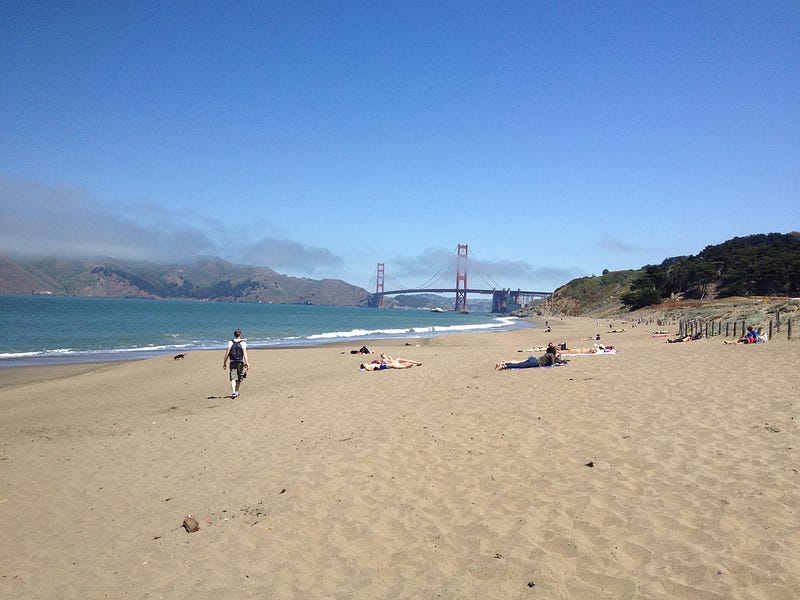
troll down 18th street or visit Baker Beach on any day of the week in San Francisco and you’ll find so many people out, you’ll think it’s Saturday. You won’t be the first to wonder if anyone in this city of workaholics is actually working.

I left my full-time job and took an unstructured staycation of exactly one month. I wanted to reconnect with people whom I’d lost touch, spend time writing and reflecting and improve my diet, sleep and exercise routines. My only restrictions were from traveling, shopping and developing new technical skills. Otherwise, life was an open book.

… continue reading on Medium

Categories
Design

My month on the flexible schedule

https://d262ilb51hltx0.cloudfront.net/max/800/0*0TPkoPMQNygqsGl6.jpegStroll down 18th street or visit Baker Beach on any day of the week in San Francisco and you’ll find so many people out, you’ll think it’s Saturday. You won’t be the first to wonder if anyone in this city of workaholics is actually working.

I left my full-time job and took an unstructured staycation of exactly one month. I wanted to reconnect with people whom I’d lost touch, spend time writing and reflecting and improve my diet, sleep and exercise routines. My only restrictions were from traveling, shopping and developing new technical skills. Otherwise, life was an open book.

… continue reading on Medium

Categories
Design Journalism Language London

Guardian Adverts: still brilliant and timeless

London-based Newspaper The Guardian redesigned their print product in 2005. It won multiple awards for its use of the Berliner format along with the ease of readability, consideration of readability, flow from section to section and brilliant use of color, photography, illustration and language.

Later came the website redesign and new advert campaign. I met Creative Director Mark Porter and Special Projects Director Mark Leeds for while in London internship, research and Uni courses. More on that meeting here.

What’s most inspired is how well the redesign and team translated the print vision to their website and marketing campaigns. Nearly 10 years later, their adverts still inspire me:volumecontrolgu81

the-guardian-fact-opinion-small-61493

ownedbynooneeb21

factandopinionex21the-guardian-restraint-small-84267the-guardian-plurality-small-77172

guardian-guardian-opinion-small-89860guardian-guardian-shout-small-47784


Categories
Design

What to do with all your data; talking visualization with Sarah Nahm and Ian Johnson

Good friends Sarah Nahm and Ian Johnson came to visit me at work to talk with the design team about data viz! Read more about it here:

http://pivotallabs.com/what-to-do-with-all-your-data-talking-visualization-with-sarah-nahm-and-ian-johnnson/

Categories
Design

Apple designers – just like the rest of us

iOS7
Designers, self included, are all in a huff about the iOS 7 announcement yesterday. A curation of our rants live here: http://designerscomplaining.tumblr.com/.

Many are critiquing the aesthetic choices and departure too from their famously skeuomorphic designs. Others are upset by the color choices look saying they look too much like a children’s candyland. And many agree it looks like a pages from Windows, Android and Myspace playbooks.  Personally, I’d just like to see some consistency. In these screens alone I can count 5 different styles of icons. I like many others, agree we’ll have to see it in action to have any kind of definitive opinions.

Historically Apple ran like a creative dictatorship. Decisions were made top down and usually were quite good decisions. Many designers looked to Apple and Steve Jobs for a flashlight pointing us towards the future of design innovation. That’s what designers used to do.

But, Apple designers no longer have a direct line to god. Perhaps their new process is similar to what the rest of us have been doing all along. Prototyping. It looks something like this: 1. Design something that might work  2. put it out in the world  3. listen to what people say 4. iterate like crazy 5. ship as soon as humanly possible.

Perhaps the iOS designs look unfinished and unsure because they are. Call me crazy but is Apple user testing?


Categories
Design

Remote Control

It's a lemons lemonade kind of morning.Lot’s of friends asking how the new job is going. It’s going great. I dig my team and the work is challenging and interesting. I’m on kind of a weird project right now, but haven’t found the happy hour way to explain it. Here’s what I’m up to:

http://pivotallabs.com/remote-control/

Categories
Music Travel

Why I keep going to Detroit

This weekend marks my fourth time visiting Detroit.

Each year has gotten colder, pricier, glitzier and more crowded. Each year I ask myself, “should I bother going next year?” “am I too old for this?” “should I really have waited in line for those parties?” But, I love going to Detroit, and I’ll tell you why.

I spent seven years in Southern Indiana listening to dance music alone. I had handful of friends nearby who “got it” and lived five hours from a club that could pull in a good DJ. I was hungry for more. So hungry. I wanted to hear these tracks on a big systems; I wanted to dance to deep house; I wanted a community of people who would love dance music with me.

So five years ago, RossBobbyRyan and I hopped in my Jetta, packed some PBJs and drove to Detroit for just that. We found hundreds of other Midwesterners from Ohio, Iowa, Michigan, Indiana and Illinois looking for the very same thing. It also was the first introductions to the music family I now have in San Francisco.

Everyone at this festival is choosing to be there. The kids, the grandmas, the DJs. Unlike the European and coastal festivals, Detroit has a high barrier to entry. It’s seen as unsafe and grungy. That filters out casual listeners who go to WMC, Sonar and BPM. The vibe has changed through the years and nothing ever is what it was. But it’s magical there and reminds me that I now live in a musical candy-land.

There is so much love in Detroit. I love being able turn to the person next to me strike up a conversation or share a friendly nod during a great track. It’s just not like that in San Francisco. I don’t know if people during this festival are so nice because it’s the midwest or because they too have finally found people to dance with. I guess it doesn’t really matter. But it’s beautiful.

I’ll probably go back next year, skip the festival, get to venues earlier and focus on the smaller parties. And if I never go back, that’s ok, it was fun while it lasted. But I’ll say this for sure, I’ve loved going to Detroit because everyone there is hungry for more.