Categories
How we live

I Will Teach You to Be Rich [Spreadsheet Template]

Personal finance is intimidating, especially since many Millennials graduated when the economy crashed and started off their adult lives in debt. Ramit Sethi will teach you to be rich. His book I Will Teach You To Be Rich is a step-by-step plan for setting and forgetting your finances. I got really into it with my brother and geeked out making a spreadsheet based on Ramit’s Framework.

Please keep in mind our spreadsheet is a compliment, not replacement, for Ramit’s book. The percentages and dates are samples and are different for my personal budget.
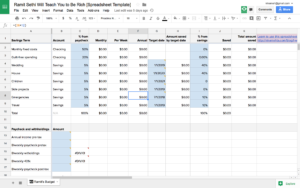
I Will Teach You To Be Rich [Spreadsheet Template]

  1. Read Chapters 1-4 of I Will Teach You To Be Rich
    This spreadsheet specifically refers to Chapter 4 (39% way into the book) but the first three chapters are important setup. This book is especially great on Kindle. Even if you’re usually a paperback person, having it on the computer like a reference document, using the Kindle Desktop App, was helpful.
  2. Make a copy of the spreadsheet
    File> Make a copy
  3. Only edit the cells in highlighted in blue 
  4. Input numbers from your paycheck (Cells B13-B17)
    The numbers on your payslip tell you how much money you earn, and thus how much money you can spend and save.
  5. Adjust your savings percentages (Cells C2-C9)
    These percentages help you decide how much money you can allocate to different categories of spending. In my spreadsheet I made a new row for each of my savings goals. This will then calculate how much to auto-transfer to a high yield savings account every month. Add or remove as many rows as you like as long as the percentage equals 100.
  6. List your fixed expenses (Cells B23-B27)
    Enumerate each expense you have every month. Now compare the Monthly calculated total (B23) with D2 (Monthly fixed cost). Adjust the numbers so they come close to matching. Ramit offers many specific tips to lower your monthly expense (and how to get a raise).

    Ramit recommends

    • 50-60% Fixed Costs (rent, utilities, loans, etc)
    • 10% Investments (401k, Roth IRA, other investment funds)
    • 5-10% Savings (gifts, house, down payment, unexpected expenses)
    • 20-35% Guilt Free Spending (dining out, music, burning man, etc)
  7. Bonus activity
    1. Money in savings (B23)
      If you want help re-allocating your existing money into higher yield accounts, list the amount of cash you currently have here.
    2. Target date (G4-G9)
      What is all this saving for? You may not know if you want to get married, have children or buy a house. However, if it’s something you’re considering, this can help you estimate how much saving you need to do now for possible big expenses in the future.
    3. % from savings (I2-I10)
      Looking at raw numbers can be overwhelming. Allocating savings by percentage makes it easier to parse and prioritize numbers. This column can help you re-allocate any cash you have that you want to redistribute into high-yield savings or investment accounts.
    4. Total (K2-12)
      This column shows you how much you will have saved by your target date (existing savings + future contributions). It does not account for interest.

Good luck, have fun, and stay positive. You may be pleased with how much money you have or disappointed by how expensive it is to live in today’s world. But rest tonight knowing you are ahead of the curve by having awareness and approach for your finances.

Categories
How we live

Frameworks for life

I love organized patterns, structures, and frameworks. They reduce stress, cognitive load, and decision making on topics where I lack expertise. That means I spend more time focusing on the parts of life I care about. Here are my favorites:

Finances

Ramit Sethi teaches you how to set your finances on auto-pilot. Make money when you’re sleeping and enjoy a nice pool of money called Guilt Free Spending. It took me about six months to get finances buttoned up but it was pretty painless, and to be honest, quite fun. He writes a language easy to understand with anecdotes that make a scary topic accessible.

Home

Marie Kondo believes when our home is a happy place, we can bring our lives into a happy place. Her framework is famous for finding items that spark joy, but her system protects from rebounds or doing a little cleaning every day. Patterns like similar items together and make sure all items are visible in a drawer are small changes that have huge impact.

Art

Julia Cameron’s self-directed 8-week course of writing every morning and taking yourself on artist dates is blissful, inspiring, and challenging. She helps you unblock creative insecurities, experiment with art, and do daily self-reflections. She and I both believe, everyone is creative and can be an artist.

Health

The Whole 30 diet is a true challenge. It’s an elimination diet that only allows for fruit, vegetables, and meat. No sugar, dairy, grains, beans, booze, honey, soy, etc. The authors say

This is not hard. Don’t you dare tell us this is hard. Beating cancer is hard. Birthing a baby is hard. Losing a parent is hard. Drinking your coffee black. Is. Not. Hard. You’ve done harder things than this, and you have no excuse not to complete the program as written. It’s only thirty days, and it’s for the most important health cause on earth—the only physical body you will ever have in this lifetime.

That’s some tough love. I am still working on finding a way to integrate my Whole 30 insights into a daily lifestyle. Stay tuned on that.

Categories
Design

How we live is how we make

This was originally posted on superyesmore.

Our world today is designed to be instant, connected, and fast.

Us software people say the apps we make help people do more, in less time. We are more productive than ever. We live, make, and work in a world where more is supposed to be better — but at a cost.

Some of the original makers at Facebook and Google now say “our minds are being hijacked.” The price to live in a beautifully connected world is putting up with the frenetic 24-hour news cycle, empty swipes for dates, and endless little red badges on our phones like stubborn pimples that won’t pop.

Our state of mind is visualized in the products we create. How can a designer in a mental state of chaos create something calming and joyful to use? It’s hard to conceive. Even worse, that chaotic software then goes out into the world perpetuating an already distracted society.

Less but better

I believe technology can be calming and joyful to use. It should improve the quality of our lives, including our mental state. But that must start from us, the makers of technology ourselves.

The faster my life moves, the less I get done. I make mistakes, forget important details, and take longer to generate good ideas. It is our responsibility as makers of tools and services to take care of our own minds and bodies to make thoughtful decisions about our products for our users.

Even in the Bauhaus School, Professor Johannes Itten dedicated the entire first year to teaching students to build an intimate familiarity with their own body, mind, and materials. He believed it was required for creative success. The Bauhaus movement went on to directly influence designers like Steve Jobs and Dieter Rams

“My first morning periods in class began with relaxation, breathing, and concentration exercises to establish the intellectual and physical readiness which make intensive work possible. The training of the body as an instrument of the mind is of great importance to a creative person.

How can a hand express a characteristic feeling in a line when the hand and arm are cramped? As we breathe, so we think and conduct the rhythm of our daily routine. People who have achieved great success in their lives always breathe quietly, slowly, and deeply. Those who are short of breath are hasty and greedy in their thoughts and actions.” —Design & Form: The Basic Course at the Bauhaus by Johannes Itten

Every weekend, I do a hard reset. I take my mind and turn it off, then turn it on again. It files away the week behind and prepares me for the week ahead. It’s my happy hour.

Nina’s Happy Hour

Saturday mornings are a special time in San Francisco. The city rests under a quiet blanket of fog for a short relief from calendar invites, side projects, and last minute bookings to wherever.

All I see from bed is a soft infinite white sky thinly veiled behind my grey linen curtains. The cool wet air diffuses the colors in the what-would-be-sunrise. It mutes the morning tweets and jangling dog collars that are out walking my neighbors.

I look at my phone when I wake up. I would love to be someone who doesn’t.

Usually I have about an hour in bed to slowly read nice emails I snoozed until Saturday at 8:00 am. These are wandering reads without any focus on replying or achieving inbox zero. It is a distinctly different read than on a given Tuesday.

My Saturday mornings hinge around a 9am yoga class in the Castro with someone who started teaching before most startup founders were born. She knows me there. They know me there. We see each other and smile and never have to talk.

I roll out my matt on the hardwood floor. Everyone is on airplane mode.

Sometimes in downward dog, I wonder if this is why people go to church on Sundays. Not so much for actual scriptures or path to god. But for a reliable and predictable time to do not much more than doing nothing at all.

Sometimes while laying in corpse pose at the end of class, I fall asleep for what feels like an hour. I roll up my mat and sling it over my shoulder and bet myself how long I can go without checking my phone.

When I re-emerge on Castro street, the Muni bus screeches by and the sun has burned through the fog. I see waiters pouring boozy mimosas at Harvey Milk’s diner around the corner from the row of kinky sex shops.

But I never miss the stroll across the rainbow sidewalk to see my guys at the florist. At this point they know me too and know my routine. The air is cool and sweet in their small rainforest of fresh cut flowers.

I pick a $5 bouquet from the black painters bucket on the floor in the back corner. I buy one every Saturday. Sometimes tulips, sometimes lilies, and sometimes lavender spiky stems I’ve never seen before. They wilt away with the week because, hey, they’re from the $5 bin.

Nina’s Happy Hour goes all morning. After a shower, I give my space a quick tidy. I toss away last weeks flowers, clean the vase, refill the water, and start again fresh. Marie Kondo says a cluttered home is cluttered mind. I feel relief when my laundry is neatly put away.

It’s barely noon and I can still make it for brunch. I could have slept in. It’s easier to sleep in. But I get more out of my week by doing less on the weekend. Rhythm is essential for a city without seasons.

The weekend is my time to daydream, take care of my home, and check in with my neighborhood. It’s a time to strengthen my body and soften my mind so I can bring intellectual and physical readiness to intense and productive work. After all, how we live is how we make.