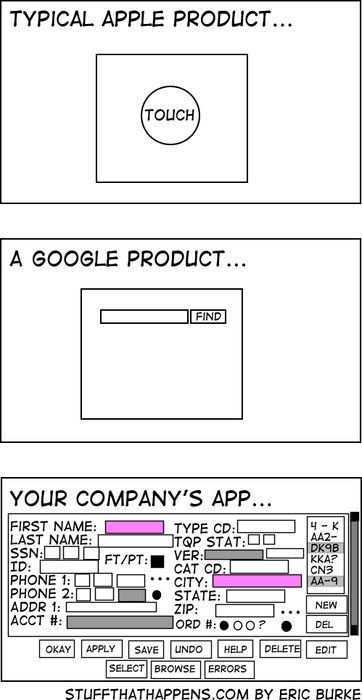
How can we design and satisfy so many people at once? This is one of our challenges.
 I saw a presentation last summer by Shan Carter that reflects on two kinds of users (consumers and readers) we design for in our work. There are people who want to enjoy something at the surface level and understand the basic simple functions or principles. Then there are the kinds who want a great depth of knowledge and understanding about the given topic. These people want to go layers in. This is a challenge Carter tries to solve in his work. He wants his designs to appeal to both users at the same time. How can he appeal to both the Bart and Lisa Simpson’s in his design?
He’s trying to build work for “both Bart and Lisa Simpson,” meaning that it can be surface and simple (like Bart) or deeper and thoughtful (like Lisa). It’s a good way to think about making work that appeals to two very different kinds of readers. –Matt Ericson
I’ve been practicing this technique while sketching for a mobile quiz app project. How can Bart fly through a quiz or quickly get information about where Auntie Selma and Grandpa are lately? Whereas we also had to think about Lisa, who is using the same app and will want to understand the reasoning by her quiz result. It’s not easy to design for both but that’s why we’re practicing.
Designing (words, apps, globes, graphics, refrigerators and stories) can be done layers.
I hear this layering technique in the podcast Radiolab. Here, the two hosts explain a very complex scientific concept that is easy to understand for someone who knows nearly nothing about the topic. But the same story is still intriguing for a listener may be quite involved in the field. These complexities make storytelling so beautiful.
Telling stories is one of the oldest ways of recording history, isn’t it? But we have so many tools to express ourselves now, it’s just amazing. We’ve gone from scriptures on cave walls to beautiful Twitter visualizers like Twistori and WeFeelFine from people all over the world expressing love, hate, desire, indifference, fear and everything in between.

The cavewall concepts is not mine, but it influenced the way I experienced the theatre production of Boom.
Boom is told in a series of layers. The narrator, off stage, is telling us a story. This story is the one the audience believes they have come to see. But it ends up being something much more grandiose.
It takes place in an underground hatch with a a scientist and young journalism student who have been brought together by the fate of science and craigslist at the world’s end. They are the last two surviving humans on earth. This human apocalypse has only been predicted by the scientist who pulled data from the sleeping behavior of sleeping. At first, this seem trivial to the story. The fish could have been plants, the moon or mooing patterns of cows. But it soon becomes clear to the audience that the story of the fish, caged up in their tank, ignorant of the world around them reflects the same ignorance our two characters in the hatch are experiencing. They have no understanding of their post-apocalyptic world. Their story is the same story as the fish. These are the subtle layers and parallels I am exploring, the layers Bart Simpson does not care about.
But before the world’s end, our female lead, was simply searching for a story to write for her magazine class. But when her life is in peril and world has disappeared, she continues to develop this story. Throughout the scenes she pauses to record moments in time. That’s how she arrived at this hatch to begin with. She came there to find a story about the despair of being human with human carnal needs.
Our scientist, wants to make his mark in history. He wants his story passed down as the next Adam of Adam and Eve. He wants everyone to tell his story; to be remembered. Their story does get told, but now how they hoped. SPOILER ALERT: Eventually, they escape the hatch and are swallowed by the great waters that have flooded the Earth. This is much like the tiny fish, living in the tank, that eventually evolve and spawn into the next major race on Earth. So, this part of the story is for the Lisa Simpson.
From Boom I feel more inspired to narrow the way I want to tell my stories. It’s okay to pause, step out of the scene, and talk about the situation or experience on a meta level. The interaction with the narrator, who had so much passion about the story, built a deeper connection to the story rather than disjointing us from what was happening. I hope my future stories and designs will have more pause and focus.